

One of the key drivers of your website’s search performance is its topical authority. If Google perceives your site as a strong, credible expert in a specific topic, it’s much more likely to surface you for queries related to that topic.
Historically, though, topical authority has been ambiguous. We knew things like content clusters and internal linking helped, but the exact mechanisms underpinning ‘authority’ were always unclear.
In 2024, that changed. A Google leak exposed a scattering of different search metrics, including siteFocusScore and siteRadius – both of which directly impact topical authority. Keep reading to learn exactly what they are and how you can improve them.
Evidence for siteFocusScore and siteRadius
Before we explore exactly what siteFocusScore and siteRadius are, let’s look at the evidence for their use as ranking/reranking factors. Google’s algorithm, after all, is something of a black box – there’s no documentation or clear deterministic system that we can follow. Instead, most SEO levers are established as such through a combination of:
- public statements and general guidance from Google (which are frequently incomplete or misleading)
- anecdata and, occasionally, reproducible experiments
- logical inference
- data leaks and court testimony.
siteFocusScore and siteRadius are children of the latter.
On 13 March 2024, an automated bot called yoshi-code-bot published thousands of files on GitHub. Those files appeared to come from Google’s Content API Warehouse – a massive data repository containing documentation about how Google stores, structures and categorises data across its services.
Almost 2 months later, Rand Fishkin, co-founder and CEO of SparkToro, was contacted by an anonymous source who’d discovered the files. The files were subsequently confirmed as authentic by multiple ex-Google employees.
For further reading about the Content API Warehouse leak, see Michael King’s and Shaun Anderson’s analyses.
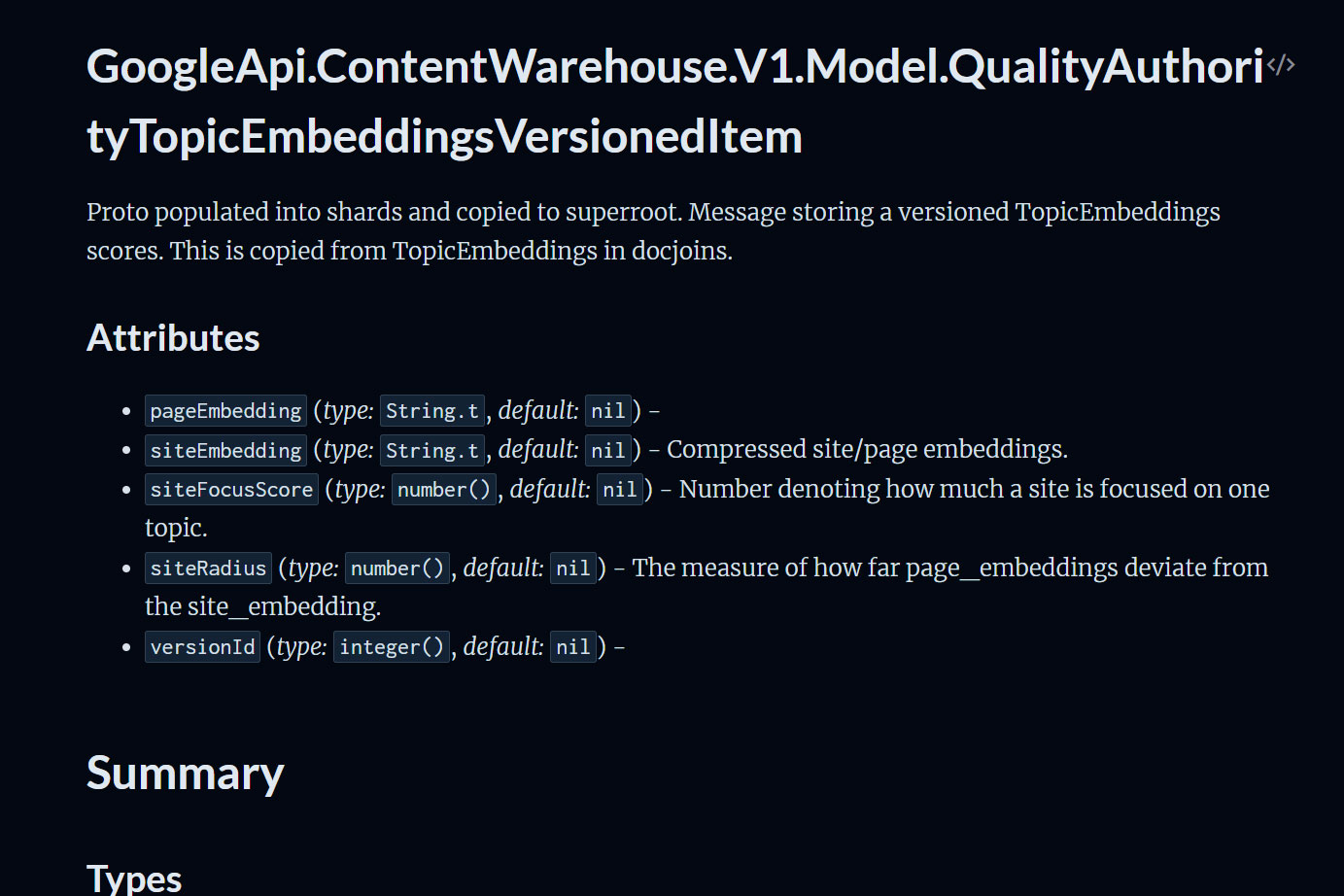
Buried within those files, in a module called QualityAuthorityTopicEmbeddingsVersionedItem (catchy name, I know), were a quartet of innocuous attributes:
- pageEmbedding
- siteEmbedding
- siteFocusScore
- siteRadius
Each of those attributes appears to be a complementary metric that may feed into Q* (Q-star), a keystone quality scoring system.
At the time the Content API Warehouse leak files were released, both siteFocusScore and siteRadius were used in Google’s search algorithms. More than 2 years have passed, though, and it’s possible that the exact metrics have been made obsolete or changed in some way. My opinion: given that most brands can’t deliver true expertise across a broad range of topics, the attribute quantified by both metrics (that is, a site’s conformity to a given topic) will continue to influence organic search performance.
What Are siteFocusScore and siteRadius?
siteFocusScore and siteRadius are metrics used by Google to evaluate how closely a website sticks to a single topic. They’re both site-level numerical scores (likely between 1 and -1). In the documentation, siteFocusScore is defined as a ‘number denoting how much a site is focused on one topic’. siteRadius is defined as ‘the measure of how far page_embeddings deviate from the site_embedding’.
Mechanics of the Scores
Disclaimer: I’m not an expert in machine learning. I’ve done my best to distil the mechanisms behind both scores into plain English, but I’ve almost certainly oversimplified some technical concepts. For an accessible (and correct) explanation of vector embeddings, I suggest reading Microsoft’s introduction for developers.
To understand how siteFocusScore and siteRadius work, we first need to look at a concept called vector embedding. Vector embedding is, at a basic level, the process of converting objects – like text – into numbers that machines can read.
Normally, that process starts when words are fed into an embedding model. The model will break each word down into fragments – known as tokens or chunks – and then map it onto a multidimensional embedding space. (These aren’t your high school Cartesian planes, either. Most modern embedding spaces have upwards of 1,000 dimensions.) The result: the word becomes machine-readable as a list of floating point numbers – a vector – within the space.
In isolation, a vector isn’t really useful. When billions of chunked/tokenised words are embedded, though, machine learning models can use them to understand how different concepts relate to each other. For example, vector embedding lets a machine comprehend that the words ‘dog’ and ‘canine’ are very closely related – even though they don’t have any linguistic components in common.
If you’ve been in the SEO space for a while, you might remember when exact-text keyword matching was a thing. To rank for ‘seo agency gold coast’, for example, you’d need a web page containing that specific phrase. Today, semantic search – which uses vector embeddings, as well as other techniques like knowledge graphs – has replaced keyword matching.
Now, while standard vector embedding is great for understanding relationships between words and even sentences, it’s not as helpful for documents (like web pages), which typically contain tens or hundreds of thousands of tokens/chunks. That’s where topic embedding comes into play. A topic embedding model works by grouping related words in a document into semantic clusters. Each cluster has a centroid – the mean of its various embeddings, which a machine can use to determine the core topic of that cluster. Those centroids can then be analysed as a group to determine the overall topic of the document.
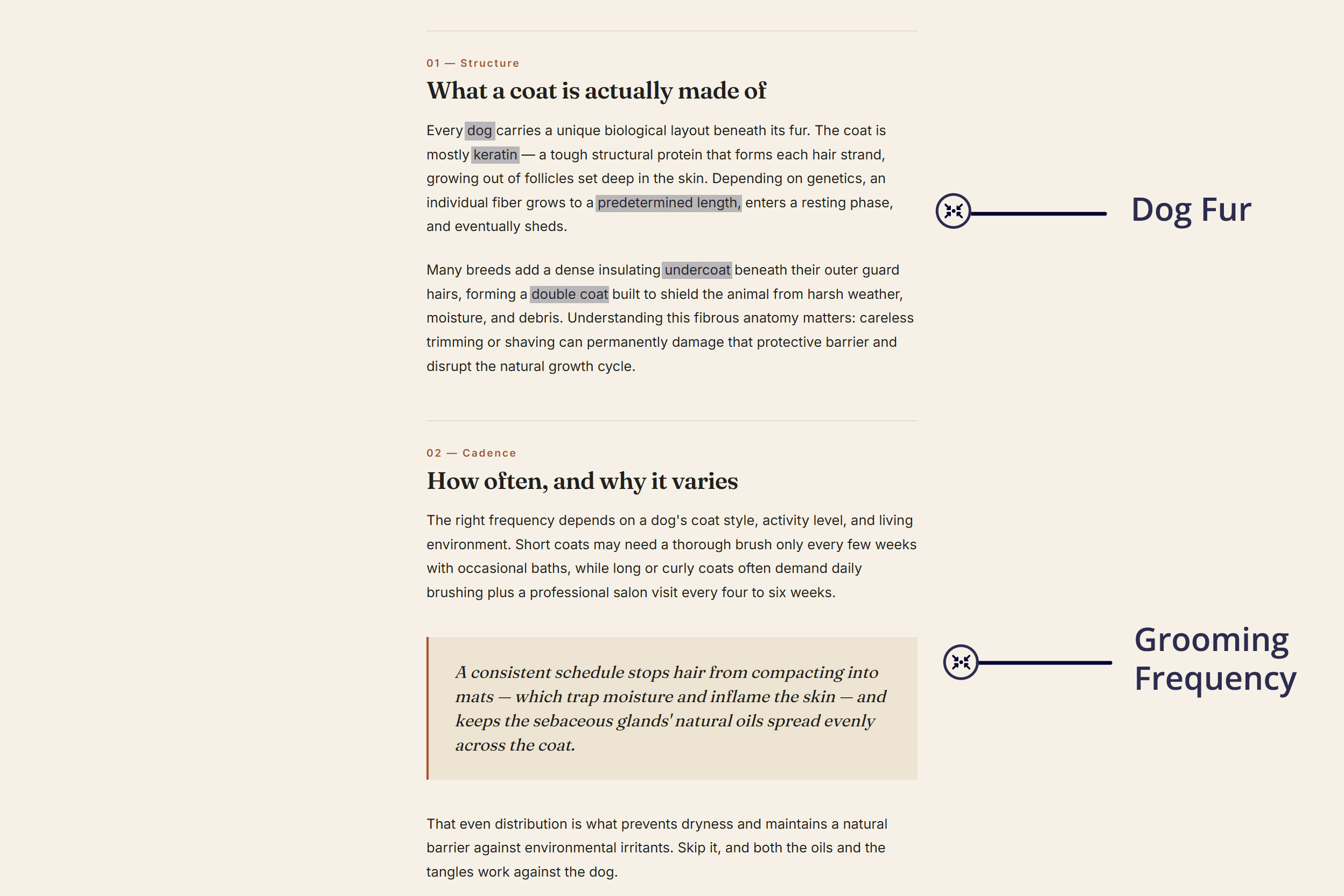
If, for example, you had a paragraph about dog fur in an article about dog grooming, a topic embedding model would know from its training data set that words like ‘canine’, ‘coat’, ‘keratin’, ‘predetermined length’, ‘undercoat’ and ‘double-coat’ point to ‘dog fur’ being the cluster centroid. It might then look at other centroids in the same document – ‘grooming frequency’, ‘shedding coats’, ‘toy dog coats’, ‘terrier coats’, ‘gundog coats’ – to understand that the document as a whole is focused on dog grooming.
That page-level semantic understanding is probably the mechanism behind the pageEmbedding attribute. Once an algorithm understands what a page is about, it can embed it within a space – and then do the same for all other pages on the site. From there, it can calculate siteEmbedding, which is likely a centroid (overarching topic calculated as an aggregate of the page embeddings) for the whole site.
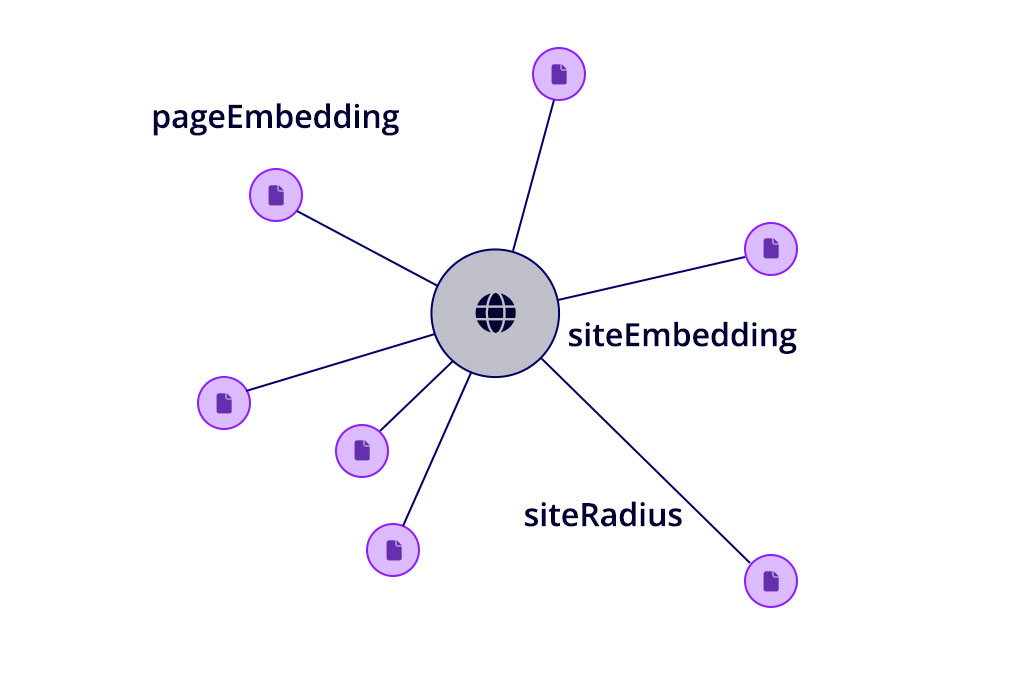
You can probably see where this is going. We now have topics determined for all pages, and for the site as a whole. Those 2 factors are likely used to calculate siteRadius. Based on the definition provided, it’s probable that siteRadius is the distance between a single page embedding and the site embedding (which is likely calculated via cosine similarity, the most widely used method for measuring vector relatedness).
siteFocusScore, then, is probably something like an average of all siteRadius scores – although there could certainly be other weighting factors incorporated as well. As defined in the documentation, it calculates how tightly clustered your site’s pages are around a given topic.
If you’re feeling a little lost, think about it like this.
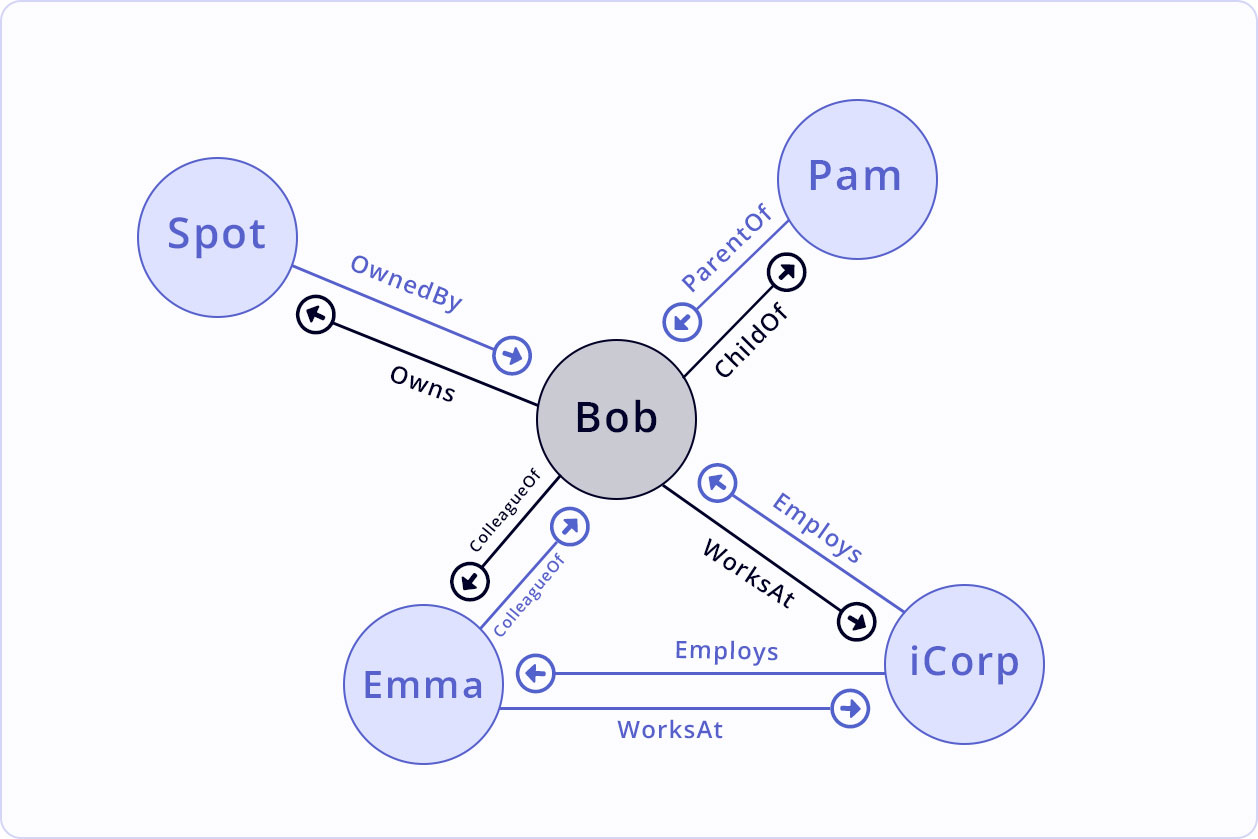
- pageEmbedding calculates the main topic for a single page.
- siteEmbedding calculates the main topic for the whole site.
- siteRadius calculates how related a single page’s main topic is to the site’s main topic.
- siteFocusScore calculates how tightly focused a site is on its main topic.
Impact of the Scores on Your SEO
So we know how siteFocusScore and siteRadius work, and that they’re probably ranking/reranking factors. But what impact, exactly, will a lower score or larger radius have?
Well, assuming siteFocusScore feeds into Q*, a sitewide quality signal, we can expect that a poor siteFocusScore will negatively affect sitewide performance during reranking. Based on Google’s guidance – which states that sites should ‘have a primary purpose or focus’ – a site that flits wildly from random topic to random topic is much less likely to be trustworthy and authoritative, and is, therefore, less helpful to searchers.
You’re probably thinking, ‘But what about news sites?’. Google actually has specific signals that differentiate news sites from ‘standard’ websites. News articles also tend to be treated quite differently to other forms of website content, and most large publishers have robust backlink profiles. Together, those factors probably offset or even nullify low focus score.
It’s also likely that a single page with a large siteRadius score – which indicates it’s not closely related to the main site topic – will not rank well, even if the rest of the site is regarded as high-quality. If your site was heavily focused on plumbing services, for example, and you created a single page on ceiling fan installation, a relatively large siteRadius score would affect its SEO.
Keep in mind that both siteFocusScore and siteRadius are two factors among many. A tightly clustered site with poor-quality content and a spammy backlink profile won’t outrank multi-topic behemoths like IBM or ABC News. A page with a large siteRadius score but lots of strong, topically relevant external links could quite possibly rank. Neither is determinative of overall search performance.
How to Improve siteFocusScore and siteRadius
The simplest way to improve your siteFocusScore is to define a core topic, stick to it, and ruthlessly prune anything that falls outside that topic’s parameters. For example, if your site is about coffee, don’t randomly deviate into topics like café food or ambience.
Of course, the reality for most brands is a little more nuanced. A marketing agency like us, for example, is focused on digital marketing – but that comprises various marketing domains (such as SEO, Google Ads, and content marketing) that we also want to get surfaced for.
In those scenarios, a good approach is to be realistic about what pages you actually care about. With enough time, effort, and offsite signals, you might rank well for all service lines – but you’re probably better off prioritising a handful of core, closely related services, then building out content around them to keep your overall siteFocusScore healthy. For example, we might focus on SEO and Google Ads, or SEO and content marketing, or website construction, hosting and optimisation.
Good content hygiene is also critical. Make sure you review the pages and posts on your site regularly, update them appropriately, and decommission anything that is no longer relevant. If you no longer provide a particular product or service, for example, cull all related content – the SEO benefits of retention are likely to be outweighed by the detrimental impact on your siteFocusScore.
I should note that SEO is far from the only consideration when building and maintaining a website. If you have off-topic pages that serve a purpose for your brand or users, keep them there. (And, if you’re really worried about the impacts on organic search performance, no-indexing is always an option.)
Example: Bad siteFocusScore
Let’s look at an example. Erth is a holistic wellness practice that offers dietetic, physio, and sleep health services. To cover its bases, it creates content around all 3 service lines, interrogating everything from circadian rhythms to adaptogen efficacy. The resulting site is, topically, spread very thin – sleep, diet, and musculoskeletal health are such massive topics, and trying to cover all of them means Erth will never be viewed by Google as a source of genuine expertise.

Example: Good siteFocusScore
Sparkline, an electrical contracting business, approaches its content strategy differently. Its ideal projects are office fitouts, which typically include LED installation, emergency systems, commercial air conditioning, cabling, and automation. It knows that project owners typically have the most questions about the latter 3 topics, so it restricts its content to just air conditioning and automation – cabling is further away semantically, so including it in the initial content strategy could negatively affect site focus.

How to View Your Site’s Topical Foci
Google hasn’t shared a way to actually calculate your siteFocusScore – and it probably never will. Luckily, you can run vector embeddings yourself to get an idea of your site’s semantic cohesion.
The simplest way to do that is to use a tool like Screaming Frog’s content embedding. I won’t go through the specifics here (follow the link, if you’re interested), but the end result is quite striking: a visual map that shows how semantically similar each page on your site is.
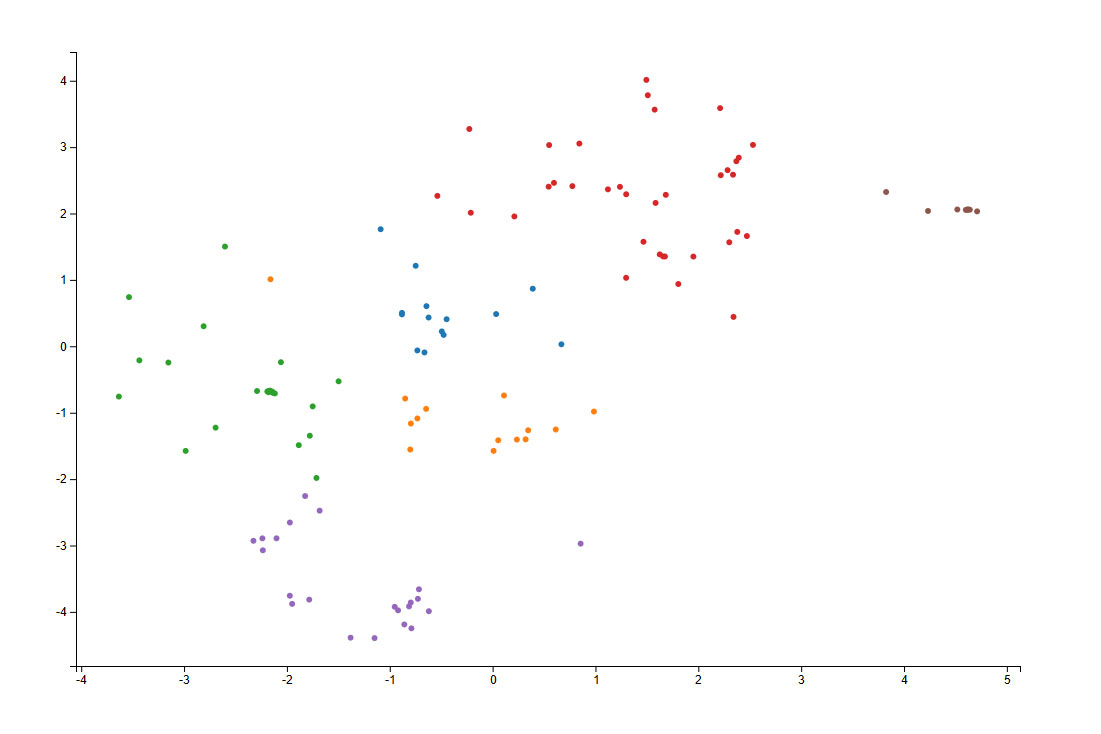
The different colours represent different topical clusters; ideally, clusters should be tight and relatively close with minimal outliers. If your clusters are scattered, thin, or far apart, your siteFocusScore is likely less than ideal. Outliers – random nodes at the edges of the visualisation – are normally a good place to start trimming.
Keep in mind that how you run the embedding will heavily affect the visualisation. For example, I’d suggest excluding thin, navigational pages such as blog category pages (which will skew your clusters) and adjusting your visualisation settings to use a ‘Most Representative’ sampling strategy with an X-means clustering algorithm.