Session 4
Can’t make it? Register and get the replay sent to your email.
In This Session
Here’s what happens next: when someone notices a photo is AI-generated or generic, they trust the business less, not more. One global study found people are four times more likely to lose trust than gain it once they clock it.
On the other side of that: a real photo of the person doing the work is the single biggest trust factor on a local business website, ahead of any other image on the page. Most people trust it over a polished stock photo, not despite it looking less shiny, but because of it.
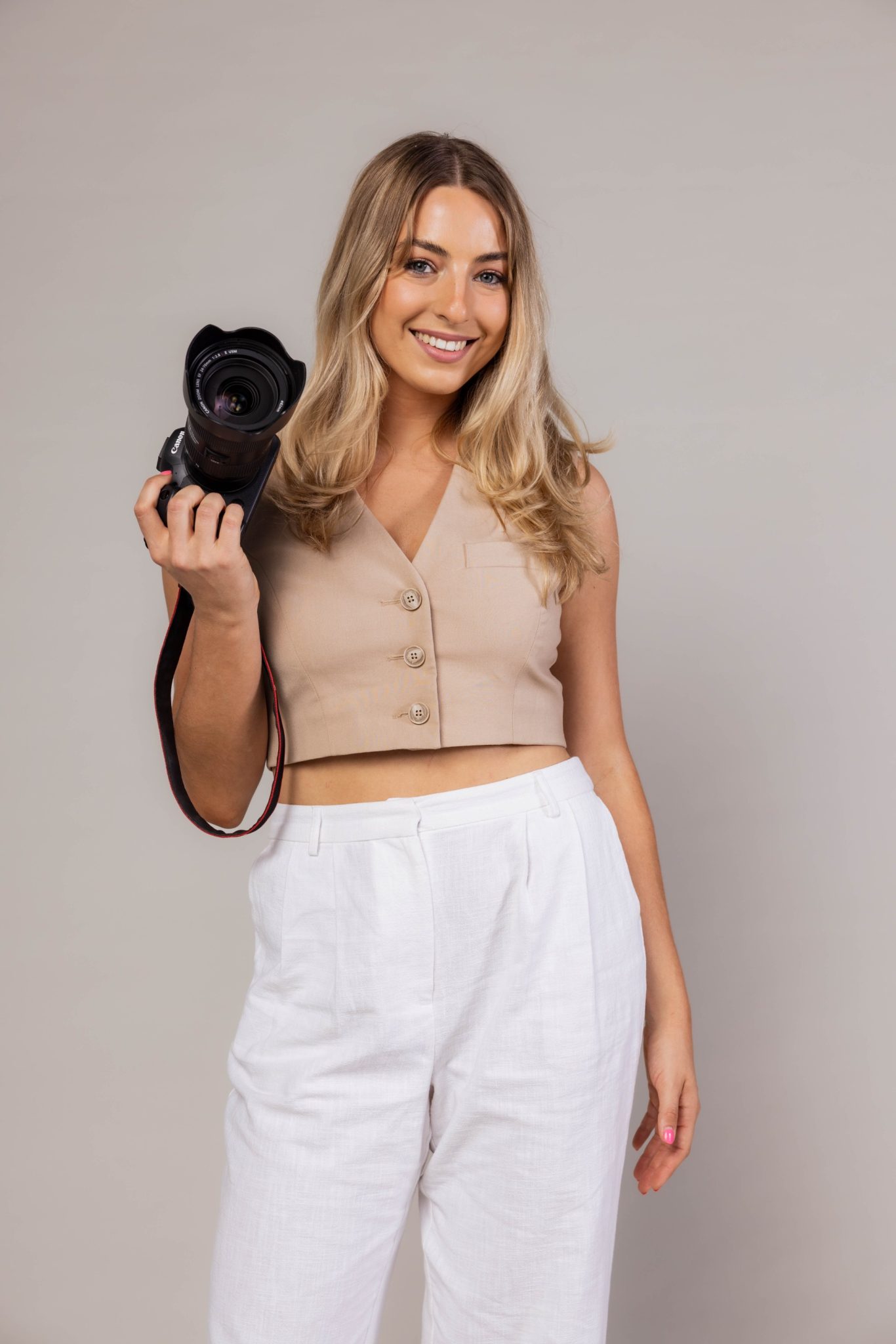
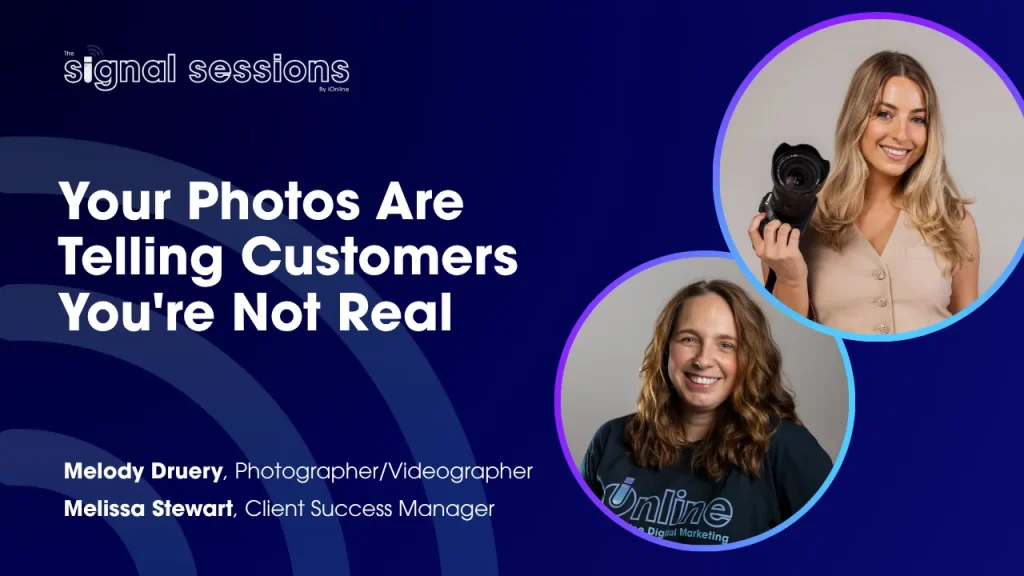
Melody, our resident photographer and videographer, sits down with us this session to talk through what that actually looks like in practice, and what it takes to get one without turning it into a production.
Got a question for Melody? Send it through beforehand and we’ll get to it live.
Hi everyone,
Thank you for joining us today.
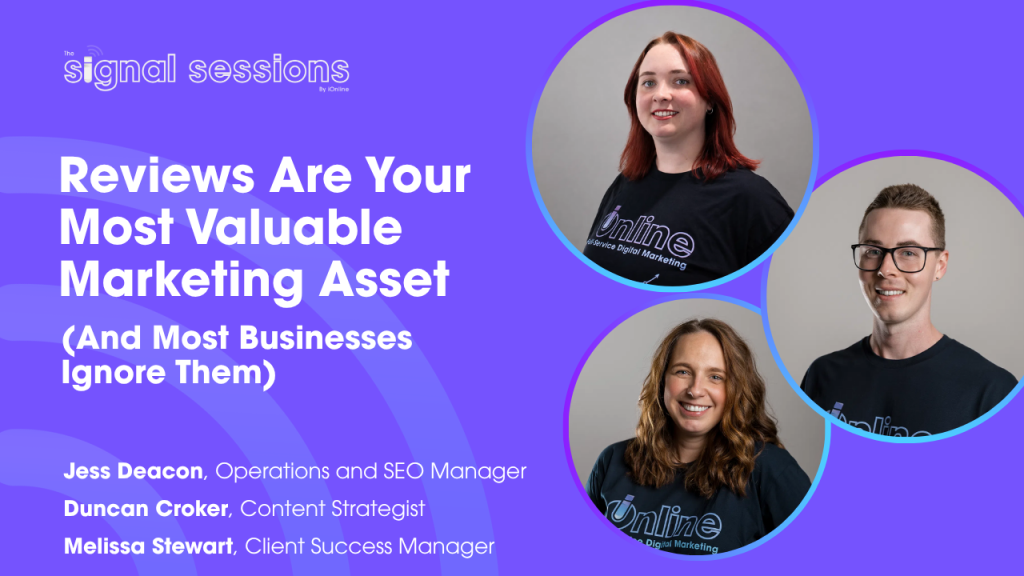
My name is Melissa. I’m a Client Success Manager here at IOnline, and joining me today is Melody, photographer and videographer.
Before we get started, a little housekeeping. You’re all on mute, but please feel free to use the chat and questions panels throughout the session. At the bottom of your screen you’ll see a couple of icons that allow you to send reactions, ask questions, and participate in the polls we’ll be running during the session.
If something pops into your head while we’re talking, throw it into the chat straight away rather than saving it until the end. We’ll answer questions as we go where possible, and we’ll also finish with a quick Q&A session.
This month we’re talking about photos, videos, AI, and trust.
Or, to put it another way, we’re talking about that photo on your website you’ve been meaning to replace for the last few years. You know the one – the staff photo from three team members ago, the headshot from before COVID, or that stock image you’ve looked at so many times you don’t even notice it anymore.
What we’re seeing more and more is that customers do notice, and that’s what we’re chatting about today.
Before we get into the conversation, we’re going to start with something a little fun – a guessing game. You’ll see some polls popping up in a second.
Melody, over to you.
Alright, we’re going to show you a few images, and all you need to do is tell us whether you think they’re real or AI-generated.
Let’s see how everyone goes.
This one’s fairly obvious. What do you think?
Looks like everyone got that one right. The hair isn’t even sitting naturally on the neck. There are so many things wrong with it!
Let’s look at the next one. It’s going to get a little harder as we go along.
That one is also AI-generated. If you zoom in, you can see some distortions in the face. Sometimes that’s what you have to look out for when trying to identify AI-generated content – slight distortions and inconsistencies.
This time, one photo is real and one is AI-generated. Tell us which one you think is real.
Most people thought Image A was the real one, and you would be correct.
The AI-generated image looks a little too perfect. It almost feels like a magazine advertisement. Real life tends to have a bit more variation and imperfection. There’s a certain lack of authenticity that’s hard to explain.
This one’s a bit tougher.
Again, it’s AI-generated.
The people all look very similar, with very little individuality or personality. Everything is so polished that it starts to feel unrealistic. It’s not always obvious anymore, but there’s still something that feels slightly off.
Now let’s compare that with a team photo from one of your clients, IT Leaders.
I really like this image because you can see everyone’s personality coming through. I know this team personally, and you can tell they felt comfortable in front of the camera. They’re all wearing the same shirt, but they each have different expressions, postures, and mannerisms. There’s genuine emotion and authenticity there.
I’d love to hear in the chat who felt confident at the start and who’s a little less sure now about spotting AI-generated images.
That’s exactly why we wanted to start here.
Most business owners assume customers are looking at their photos and thinking, “That looks professional.” But increasingly, customers are looking for something else. They’re looking for signs that the business is real. They’re looking for trust.
Recent studies have shown that 66% of people were confident they could spot AI-generated images, but 57% got it wrong when tested.
This group actually did very well because most people identified those examples correctly, so well done.
The real question isn’t whether customers can spot AI. It’s what happens the moment they suspect an image might be AI-generated.
That brings us to our first topic – why people reach for AI in the first place.
Before we get into that, I want to quickly touch on Skechers. Over the last 18 months they’ve run three campaigns that generated considerable backlash.
In 2024, they published a Vogue advertisement where the background text was unintelligible. The shoe they were actually selling appeared only as a tiny image in the corner, while the main focus was fashion models in high heels – completely unrelated to the product itself.
It wasn’t a one-off, either. There were three separate campaigns across roughly 18 months, including a billboard campaign that eMarketer referenced as part of wider concerns about declining creative standards, and a New York subway campaign earlier this year.
The issue wasn’t necessarily whether the campaigns used AI. It was that the conversation became about the imagery itself rather than the product.
Exactly.
The shoes weren’t the story anymore. The AI speculation became the story.
I found a TikTok quote about one of the campaigns that was a little harsh, but it summed up the reaction:
“You didn’t save any money because now I hate you.”
Strong wording, but it highlights how people react when they feel a brand is taking shortcuts.
It’s not just small businesses experimenting with AI to save time or money. Large brands are doing it too.
So let’s start with the obvious question:
Why do you think so many businesses are turning to AI?
Quick disclaimer – I’m not a marketer. I’m a photographer.
But from what I’ve seen working with clients and observing consumer behaviour, budget is often the biggest factor.
When you’re running a small business, paying for professional photography can feel like a luxury expense. AI is quick, cheap, and often free.
A lot of business owners assume nobody will notice.
But honestly, I think people notice more often than they realise.
When I see a brand using obviously AI-generated imagery, I immediately feel less connected to them. It creates distance and reduces trust.
I don’t think most businesses are trying to deceive anyone. They simply have limited budgets, busy schedules, or they genuinely dislike being on camera.
I agree.
A recent survey found that 45% of Australians would trust a brand less if they discovered its advertising was mainly AI-generated.
Trust isn’t something people always think about directly, but it’s incredibly important.
One thing you’ve said to me before that’s always stuck with me is that if you’re looking for a service provider and you can’t find a real face behind the business, you won’t book them.
At first I thought that sounded harsh, but the more I thought about it, the more I realised I do the same thing.
Exactly.
Anything you present as your business should feel real. Otherwise, what’s the point?
Customers aren’t analysing websites the way marketers might. They’re making lots of small trust decisions.
We’ve seen that with one of our allied health clients.
A significant portion of her client base comes directly from consistently showing up on social media and posting videos of herself. Not everyone needs to post every day, but having a recognisable face behind the brand matters.
That visibility has played a major role in the success of her business.
Let’s talk about the awkward topic – money.
Many people listening are probably thinking, “That sounds great, but professional photography costs money.”
And that’s completely understandable.
But without real content, you run the risk of damaging trust and harming your reputation over time.
When we talk about professional photography, we’re not talking about a massive production. We’re talking about building a foundation of authentic content that helps customers understand who you are and who’s behind the business.
Even a half-day shoot can provide enough headshots, website photography, and social content to last months – sometimes even years.
Photography is honestly one of the first investments I’d recommend for anyone growing or starting a business.
Just so nobody clips this out of context and accuses us of starting an anti-AI movement – where do you think AI actually helps?
I have no problem with AI.
Like anything, there’s a time and place for it. The issue is when it completely replaces reality.
That’s where things start to feel strange.
People are becoming much better at recognising when something feels off, and even when they can’t identify exactly why, they notice it emotionally.
Once people start questioning the content, they start questioning the business behind it.
When businesses stop hiding behind generic content and start showing who they really are, customers feel like they already know them.
They aren’t just interacting with a website or an Instagram account. They’re interacting with real people.
Simple things matter:
These are the things people remember.
Customers are more likely to return and recommend you because it feels like a relationship rather than a transaction.
Let’s look at some examples from recent client projects.
One client was a local pain clinic. Their previous website relied heavily on stock photography of people who didn’t actually work there.
The images were attractive, but they could have belonged to almost any clinic.
Since we were already rebuilding the website, it was the perfect opportunity to move away from stock imagery and capture real photos of the team and the clinic.
Now prospective patients see the actual practitioners they’ll meet when they book an appointment.
And it wasn’t a difficult process.
We spent two half-days across two clinics, and that’s all it took to gather enough imagery for the website, social media, and future marketing.
It’s also worth mentioning that many of the team members were nervous about being photographed.
Helping people feel comfortable in front of the camera is a big part of my job. Very few people naturally enjoy being photographed, and that’s completely normal.
We’ve had an interesting question come through about advertising platforms increasing scrutiny around AI-generated content.
I think that’s a positive development.
A lot of the concern comes from people not knowing what’s real anymore. Greater transparency helps build trust.
If a business can only afford one photography update this year, where should they focus?
Wherever customers look first.
If you’re product-based, start with your website.
If most customers discover you through Instagram or social media, focus there.
For service providers, your About page can also be incredibly important.
Make sure wherever customers first encounter your business reflects who you are today.
Let’s wrap up.
If you take away just one thing from today’s session, it’s this:
Most business owners think customers want polished, but what customers actually want is proof.
So here’s one task for everyone this week:
Go and look at the first image a customer sees when they encounter your business – whether that’s your website, Google Business Profile, social media, or somewhere else.
Ask yourself:
Could this photo belong to anyone?
If the answer is yes, that’s probably the first place to start.
If updating your imagery has been sitting on your to-do list for a while, have a chat with us. We’re excited to be officially launching our photography and video services and would love to discuss the best way to maximise a shoot day or half-day session.
Thank you all for joining us.
We’ll see you next month.
And thank you, Melody.
Thanks for having me.
Bye everyone.
Save Your Seat
Attendance is limited to 200 seats. Even if you can’t make it, we’ll send you the recording.
Wednesday 23 September 2026
People
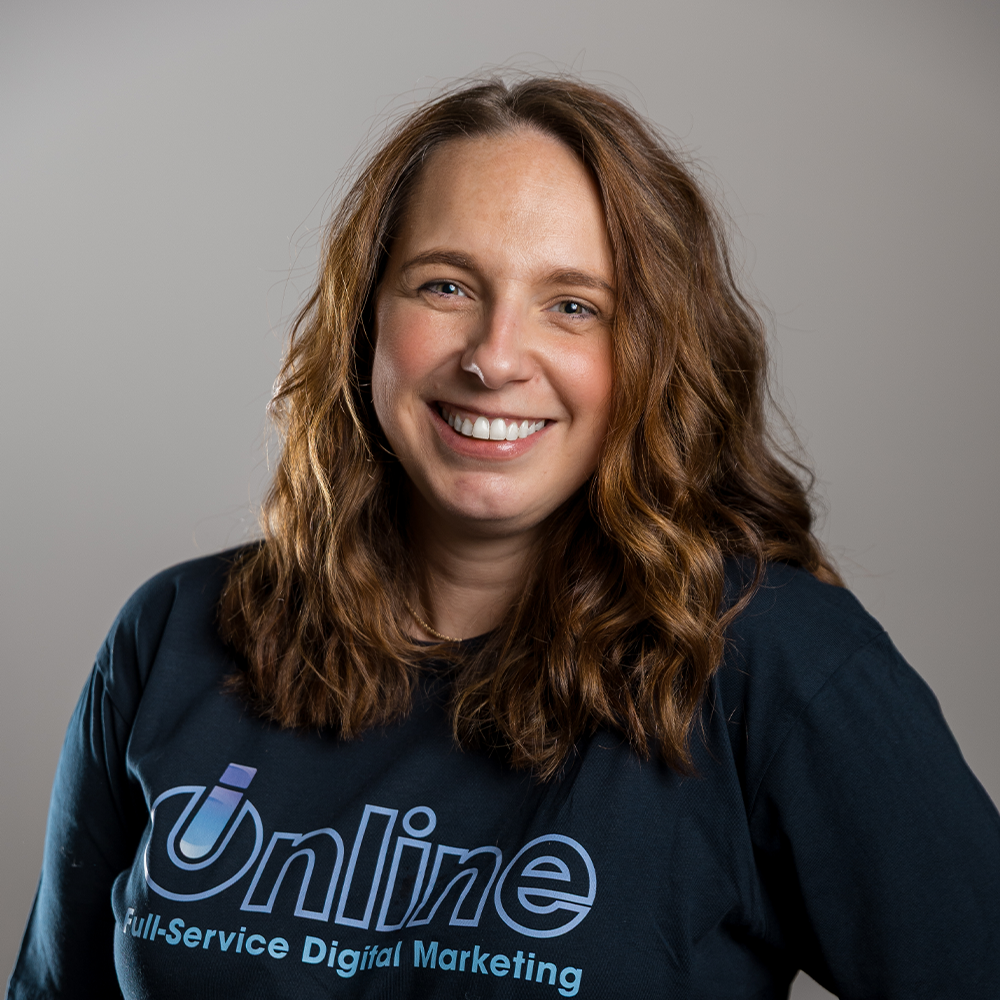
Melissa Stewart
Client Success Manager
30 minutes. Zero obligation. Online or in-person.
Team Member Name
Team Member Title

Watching: TV

Listening: Music

Reading: Book

Drinking: Drink

Quoting: Quote

Obsessed With: Love
Why I love what I do:
Enter text
I am not about:
Enter text