

Frequently asked questions are an integral part of any site – and, often, one of the most visited. But there’s a science to crafting high-quality questions that your buyers will genuinely find helpful.
This article breaks down 5 actionable tactics you can use to optimise your FAQ pages and sections.
1. Answer Actual Customer Questions
An FAQ page is about helping current or potential customers – it’s not another sales-focused page designed to persuade people. That means your FAQs should be questions that real humans frequently ask (or could ask). If you’re drafting queries along the lines of ‘Why is product X so good?’, consider whether they’d work better on a product or service page in the main copy.
Of course, thinking of questions that buyers do ask can be hard, especially if you don’t have a way for your sales and CS staff to record questions. Here are 6 ways to get FAQs without analysing calls or interviewing frontline personnel.
- Google can yield good FAQs for certain types of buyers, such as B2C and unsophisticated B2B buyers. Use suggested searches, the People Always Ask (PAA) panel, or a keyword research tool like Ahrefs.
- Reddit can be an excellent resource for certain industries. If your buyers are involved in relevant subreddits, run a keyword search using question words (who, what, when, where, why and how).
- Your Google Search Console profile is a goldmine of data. You can find FAQs that are too obscure for keyword research tools by running a regex search with the expression: (who|what|when|where|why|how). A general browse through all your search queries can also turn up some FAQs that don’t use question words. Keep in mind that GSC data will only show you queries that you’re already ranking for in some way.
- Audience research tool SparkToro can return a sizeable number of FAQs. Do note that many of them will already be identified by your keyword research tool. (At the time of writing, SparkToro is only available for US, UK, and Canadian audiences.)
- As someone who’s intimately familiar with your buyers, you might be surprised how well you can anticipate their questions. Try running a solo brainstorming session or writing down FAQs whenever they come to mind.
- You can even ask your LLM of choice for FAQs. Keep in mind that outputs won’t necessarily be data-based – LLMs are probabilistic, not deterministic, so you’ll probably get a combination of real-world FAQs and questions that the LLM thinks someone could ask.
2. Don’t Avoid Hard FAQs
No-one likes hard questions – but that doesn’t mean your buyers won’t ask them. If the processes we listed above do return a ‘difficult’ question, don’t ignore it. If you do, you’ll miss an opportunity to tackle a problem head-on and come across as competent, self-aware, and honest. (Think about the alternative; a buyer who perceives you as deliberately avoiding issues is much more likely to go with a competitor instead.)
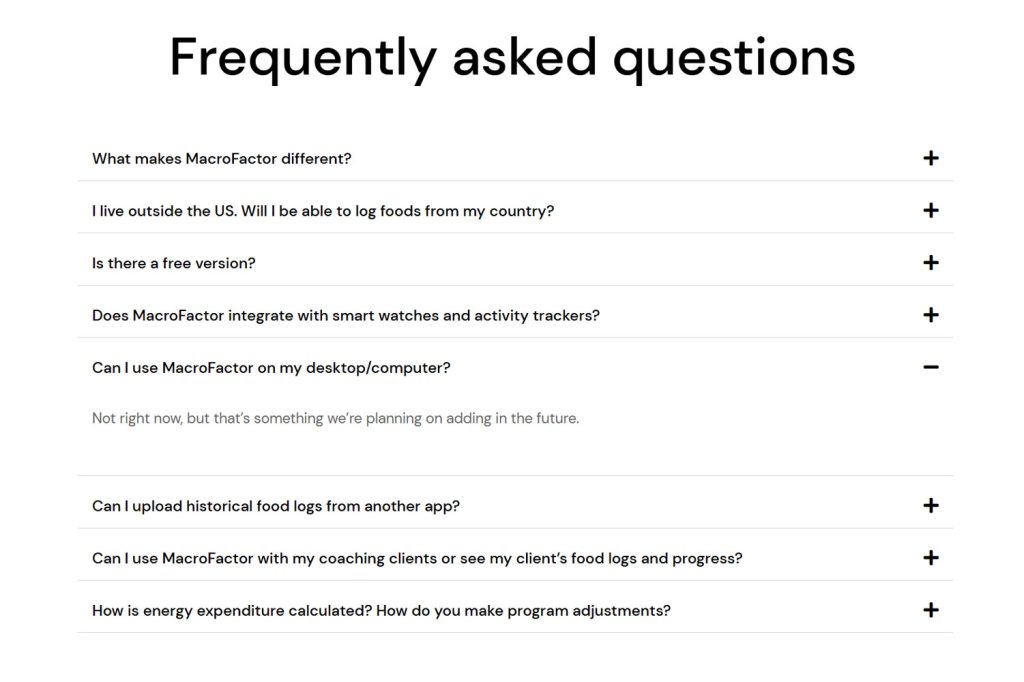
Take, for example, macro-tracking app MacroFactor. One of its website FAQs is: ‘Can I use MacroFactor on my desktop/computer?’. Rather than pretending that no-one cares about using apps on desktops, the MacroFactor team have responded: ‘Not right now, but that’s something we’re planning on adding in the future.’
They acknowledge that the app currently can’t be used on desktop, and that there’s a plan to address that obvious shortcoming. It’s an honest and straightforward response – as all good FAQ answers should be.
3. Tailor Questions to Your Audience’s Buying Stage
Always think about who’s going to be reading your FAQs and when. For example, don’t put product support questions with questions that buyers are likely to ask before purchasing. You’ll end up with an excessive number of questions in the same place and a confusing reading experience that straddles different category and product awareness levels.
If you do want support questions on your website, sequester them in a standalone knowledge base. Think about including long-form support articles and a search function as well, like Airtable’s easy-to-use help centre.
4. Make Your Questions Easily Navigable
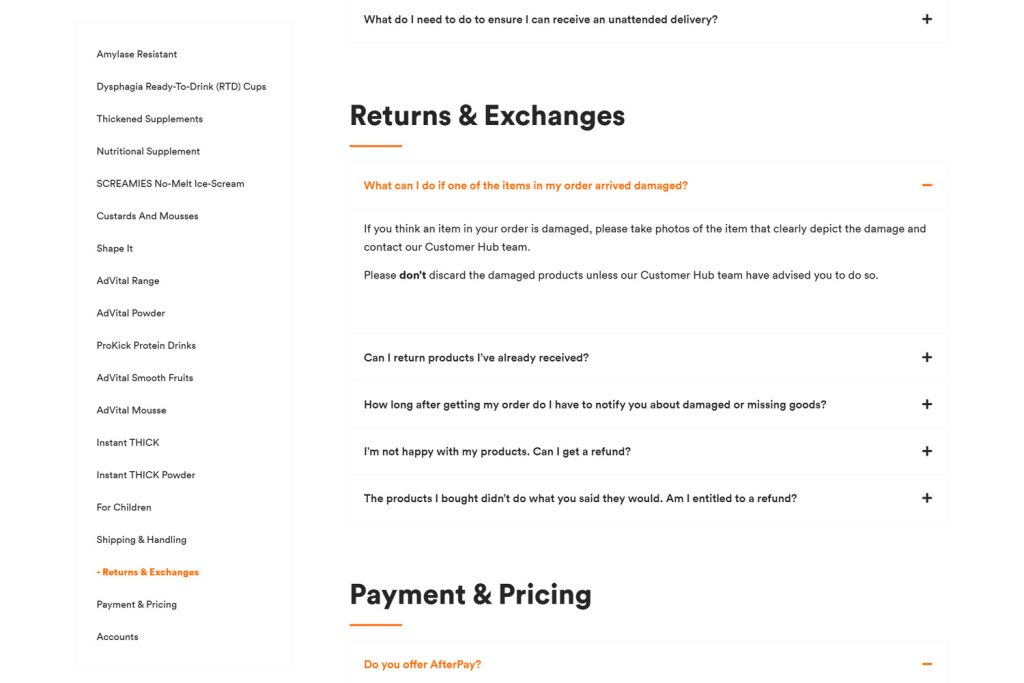
Some FAQ pages – particularly those for SaaS and e-commerce brands – can be lengthy. If your FAQs are becoming hard to navigate, consider splitting them into categories with an anchor/jump-linked table of contents. For example, you might have sections that cover online ordering, returns and exchanges, and specific product information, like this FAQ page we built for nutrition company Flavour Creations.
Companies with a high volume of customer queries will often have a dedicated support hub/knowledge base with different FAQ pages, technical documentation, a chatbot, and contact options for human support, like this site by data management app Airtable.
5. Be Concise, Clear, Specific and Helpful
Make sure your FAQ copy is:
- concise (don’t go into unnecessary detail – if an FAQ needs a lengthy response, it’s probably better answered in an article)
- clear (make the answer instantly easy to understand)
- specific (don’t give vague, generalised answers like ‘it depends’)
- helpful (actually answer the FAQ in a way that addresses the underlying concern of the buyer/customer).
Bonus Tip: Use Accordions With H3s
It’s generally a good idea to sequester your FAQs in HTML accordions with the questions themselves as H3s. This keeps your FAQ page clean and easily navigable, and is great for both SEO and accessibility.
For help drafting and developing an effective FAQ page, ask us about our web design and development services.