

Brand story. Brand narrative. Strategic narrative. You’ve heard the terms before, but you’ve written them off as marketing fluff. They aren’t. A strategic narrative is how you build a sustainable, scalable business – one that can survive market movements and changing technologies.
This guide explains what a strategic narrative is and how you can craft your own. You won’t walk away with a story you can use, but you will have the tools and information you need to get started (including a simplified narrative framework).
Three Types of Storytelling
‘Storytelling’ is a bit like ‘strategy’ – a word made almost meaningless by years of corporate misuse. *Cue slide decks filled with other buzzwords like ‘synergy’ and ‘transformation’.* But it is a real concept, and an important one. You wouldn’t be reading this article if you thought otherwise. So what does storytelling actually look like in marketing?
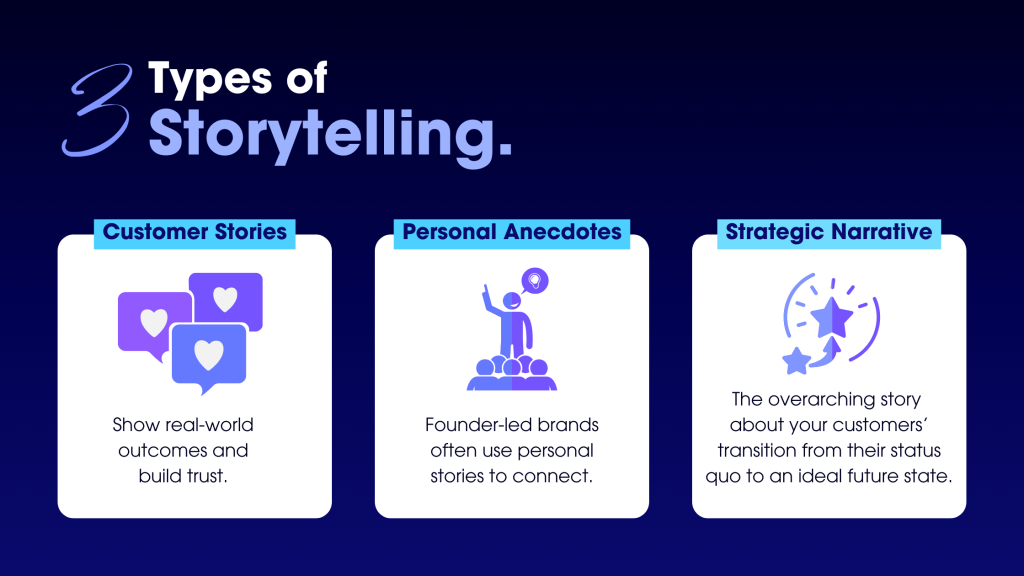
The first and most obvious example is customer stories. They’re one of the best ways to build trust in your brand, because they show that you’re capable of delivering outcomes and they show how you do it in the real world.
Another is the personal anecdote. You’ll often hear it from founder-led brands – ‘I started NewCom because I tried to do X and no company could help me.’ Sometimes, those anecdotes are burnished into myths that spread well beyond the brand, like the many Steve Jobs stories that exemplify his single-minded perfectionism or Reed Hastings’s possibly fictional Blockbuster origin story.
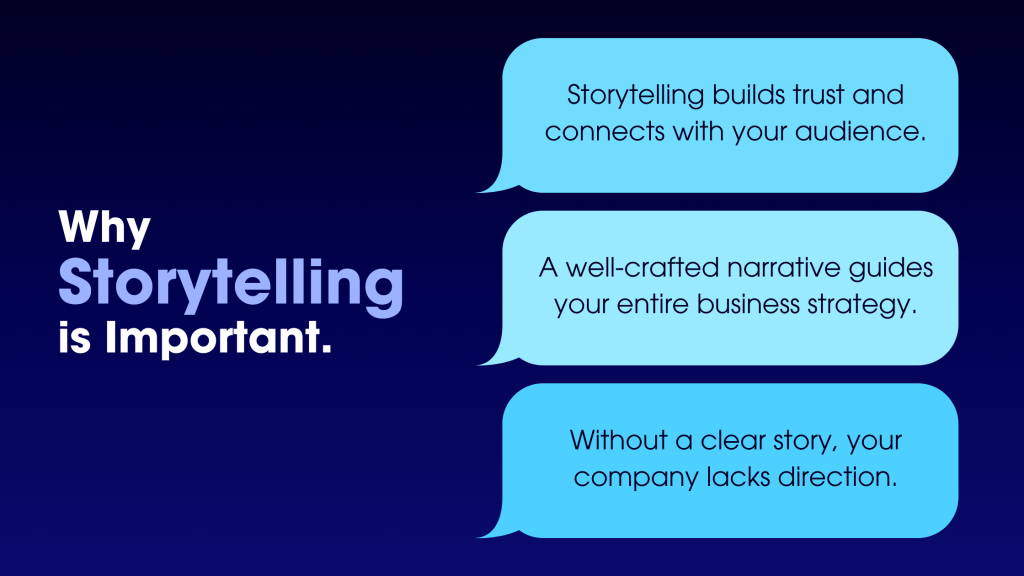
But both customer stories and personal anecdotes share a common thread: the strategic narrative. This is not your brand’s mission or vision (although both stem from it). It’s also not a jazzed-up history of your company (although those historical anecdotes we mentioned may well feed into and support your narrative).
A strategic narrative is the story you tell the market. Specifically, it’s a story about your ideal customers’ status quo – why that status quo is no longer in their best interests, what the new ‘ideal state’ looks like, and how you can help get them there. That basic structure can be refined and strengthened with frameworks like Andy Raskin’s hero’s journey. It’s a ‘strategic’ story because, done right, it will be the guiding force behind your entire business strategy. To quote Ben Horowitz of leading VC firm Andreessen-Horowitz, ‘Companies that don’t have a clearly articulated story don’t have a clear and well-thought-out strategy. The company story is the company strategy.’
Need proof that strategic narratives work? Just look at politics. Politicians don’t get elected on policy details. They get elected on the stories they tell, the enemies they define, and the hope they promise. Your brand operates at a vastly smaller scale, but it’s no different. Most prospects have already bought into a narrative – but it might not be one that favours you.
Here’s how you can tell them a different story.
Before and With: A Simplified Narrative Framework
Let’s reiterate the 3 core elements of a strategic narrative:
- Explain why your ideal customers’ status quo (A) is no longer in their best interests. You need to show that the costs of staying put outweigh the inherent risk of change.
- Define the new ideal state (B). If staying with the status quo is dangerous, where should your ideal customers go?
- Show them how you can help them make the journey from A to B. What supporting capabilities do you have?
Each of these elements is key. If you can’t sell your ICP that staying is bad, they’ll have no incentive to change the way they currently do things. If they don’t believe in your ideal state, they’ll look for someone else with a better promise. And if they don’t believe that your brand can help them make the change, they’ll also look to other providers.
Here’s an example from an integrated medical provider we worked with. Unlike competitors, it offered end-to-end healthcare services for workplaces – but it didn’t have a strategic narrative that clearly explained why that model was important. There also wasn’t an incentive for employers to invest in services beyond injury management.
Drawing on our expertise in the health space, we crafted a strategic narrative that blended the ideas of health optimisation and fragmented healthcare. Both already existed on the fringes of academia, but government and industry had yet to catch up. (Health optimisation is, basically, applying interventions to improve performance, not just prevent clinical conditions. Fragmented healthcare leads to worse patient outcomes and higher costs – something solved by this provider’s integrated approach).
The new narrative clearly defined the ideal new state and the costs of the status quo. It also used the provider’s capabilities to show how they could help large corporations make the change. In that scenario, the ‘why change’ rationale wasn’t shifting external circumstances, like new technologies or climate breakdown. It was emerging research that healthier workers perform better and that fragmented care (especially in worker’s comp scenarios) costs money and compromises outcomes.
You can do the same for your brand. Use a table like the one below to help visualise it.
| Status Quo | Ideal Future State | Your Capabilities |
|---|---|---|
| Define what the status quo looks like and the costs associated with it. | Define what the ideal future state looks like and why it’s better. | Explain how your capabilities enable the change. Focus on your USPs – capabilities most competitors don’t have. |
You can then package your strategic narrative for public consumption by simplifying that table into this one.
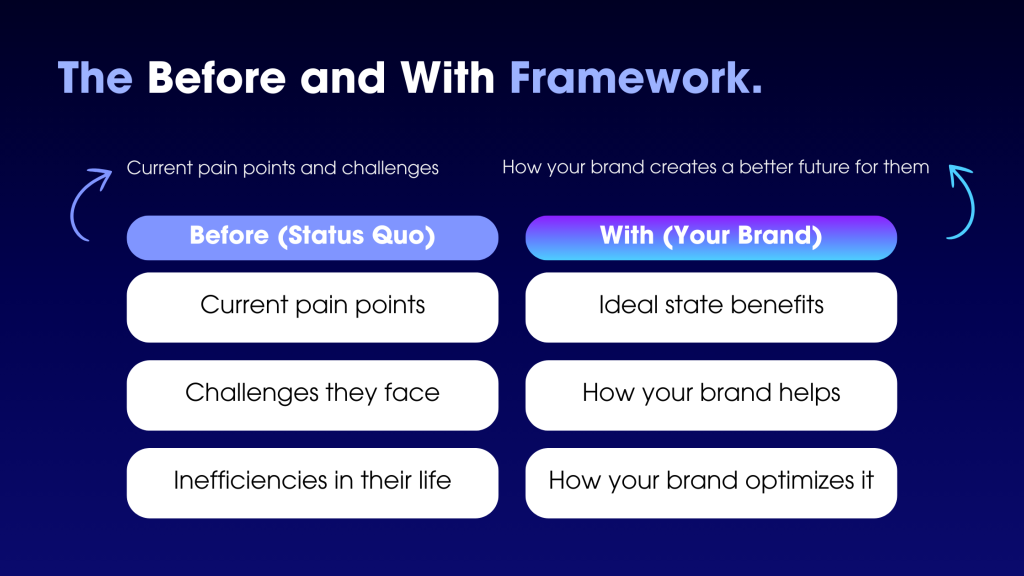
You can use the before–with table in your marketing collateral and internal/investor comms or break it down into different messaging points.
Getting Started With Your Storytelling
To be clear: you can build a successful, profitable business without a brand story. You can acquire resources, build incremental advantages, and outmanoeuvre your competitors. But all of that is much, much easier when it’s unified under a strategic narrative, because it gives you a clear direction to aim in.
Once you identify an ideal state for your ICP, you can construct a business that supports their transition by solving barriers they’ll face – rather than starting with offerings/capabilities and working backwards to see what problems you can solve.
Even with the before–with framework, though, crafting a strategic narrative isn’t easy. You’ll need to think very, very deeply about your ICP and the problems you solve for them before the thread of a viable story starts to emerge. Expect headaches, sleepless nights, and plenty of stillborn stories. It could well be the hardest strategic initiative you ever undertake – but, if you get it right, you’ll have a stable foundation for your brand to grow on.
That’s worth the effort.